
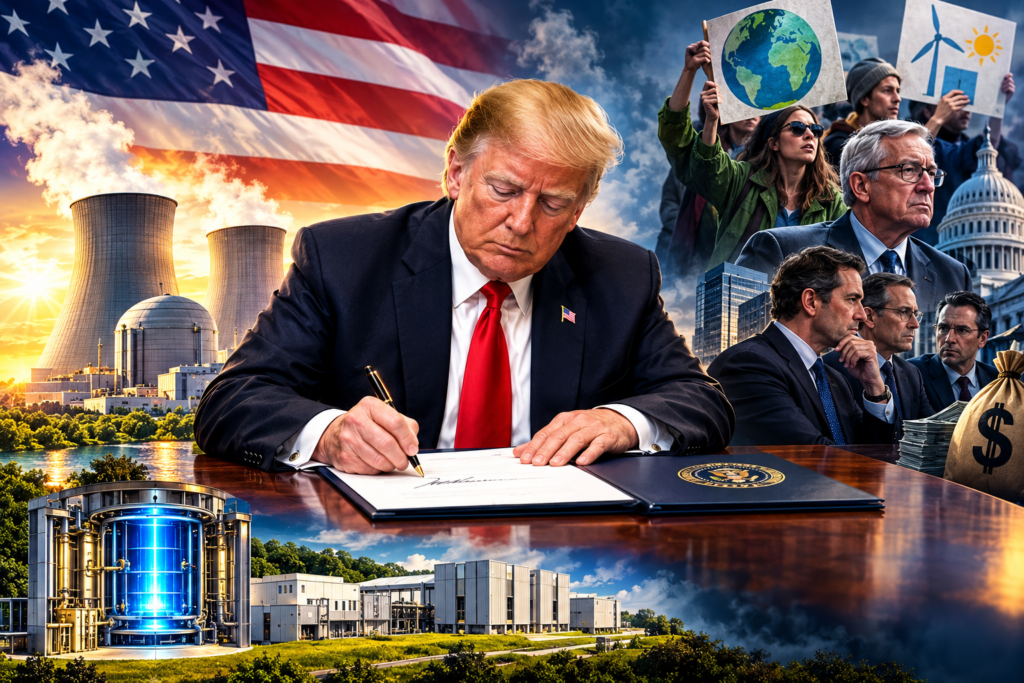
WASHINGTON, D.C. — In a direct challenge to decades of regulatory gridlock and eco-statist policy, President Donald Trump signed executive orders.
The orders aimed at slashing red tape and quadrupling nuclear energy deployment across the United States by 2050.
Moreover, the directives mandate a comprehensive overhaul of the Nuclear Regulatory Commission (NRC) and the Department of Energy (DOE).
Additionally, under the orders, the administration requires agencies to shorten licensing timelines.
Furthermore, it urges faster construction of advanced test reactors and small modular reactors (SMRs).
Additionally, it calls to reduce bloated civil service staffing and prune advisory oversight panels.
Unsurprisingly, the White House’s pro-energy push has triggered immediate pushback from entrenched federal regulators.
Moreover, environmental activist organizations and financial central planners also oppose it.
The Opposition: Activists, Bureaucrats, and Wall Street
The Opposition: Activists, Bureaucrats, and Wall Street
The push to deregulate and expand the nuclear sector has drawn sharp criticism from environmental groups that favor subsidies for wind and solar, and from career bureaucrats who want to maintain administrative power.
1. Environmental Activist Groups
Legacy green groups have vowed to fight the administration’s permitting acceleration and deregulation initiatives.
However, they will do so through judicial challenges and public relations campaigns.
Attempts to revive this dying industry are costly to American taxpayers and a danger to public health and the environment, said representatives from the Sierra Club, who argue that the administration’s focus on heavy base-load energy draws capital away from decentralized renewable grids.
Major advocacy coalitions, including the NRDC and the Union of Concerned Scientists, oppose relaxing environmental impact reviews under NEPA.
Activists warn that bypassing lengthy safety oversight and accelerating reactor deployments creates ecological risks.
Moreover, it also leaves long-term nuclear waste issues unaddressed under Trump.
2. Deep State & Administrative Bureaucracy
Pushing back against mandates from the Department of Government Efficiency (DOGE) to trim personnel and enforce strict review deadlines.
Moreover, federal staffers argue that shrinking oversight panels compromises statutory mandates.
The Commission’s primary obligation by law is absolute public safety, noted by a career NRC oversight official speaking anonymously regarding administrative restructuring. Attempting to compress complex, decades-old technical evaluation frameworks into rapid administrative windows undermines independent regulatory authority.
3. Financial and Corporate Intermediaries
Beyond activists and federal workers, corporate financial interests show a subtle form of resistance. Wall Street investment firms and utility monopolies—long used to taxpayer-backed guarantees and risk reductions from federal energy policy—stay hesitant to fund large nuclear builds without big corporate welfare packages and long-term government subsidies.
Why Advocates for Limited Government and Energy Independence Back the Plan
For constitutional conservatives, libertarians, and proponents of limited government, President Trump’s executive push represents a crucial step toward real energy dominance and free-market deregulation. (Despite the many other regulations and policies Trump has that have grown government.)
- Smashes Bureaucracy and Red Tape: The NRC has spent decades functioning as a regulatory bottleneck—imposing multi-billion-dollar compliance burdens and endless paper trails that choked out private innovation. Forcing agencies to operate with reduced staff and strict review deadlines returns power to innovators and restores baseline free-market principles.
- Delivers True Energy Independence: Unlike weather-dependent power sources that require extensive government grid management and federal subsidies, nuclear power delivers dense, continuous base-load electricity. A robust domestic nuclear fleet removes American reliance on foreign energy markets, fragile international supply chains, and volatile fossil fuel imports.
- Reclaims Market-Driven Innovation: By streamlining approval pipelines for Small Modular Reactors (SMRs) and private test reactors, the administration allows private enterprise and competitive technological innovation—rather than central planners in Washington—to shape America’s energy future.