
If you had told a Palmetto State conservative a few years ago that the South Carolina Republican Party—a machine so dominant it once treated the state legislature like its personal fiefdom—would stumble into a midterm election catastrophe, you would have been laughed out of the local Diner.
Yet here we are in late 2026. In the aftermath of the 2026 midterms, political analysts are sifting through the wreckage of what should have been an impenetrable red fortress. While establishment talking heads blame everything from shifting demographics to “voter apathy,” grassroots conservatives and libertarians know the real culprit behind this self-inflicted disaster: South Carolina GOP Chairman Drew McKissick.
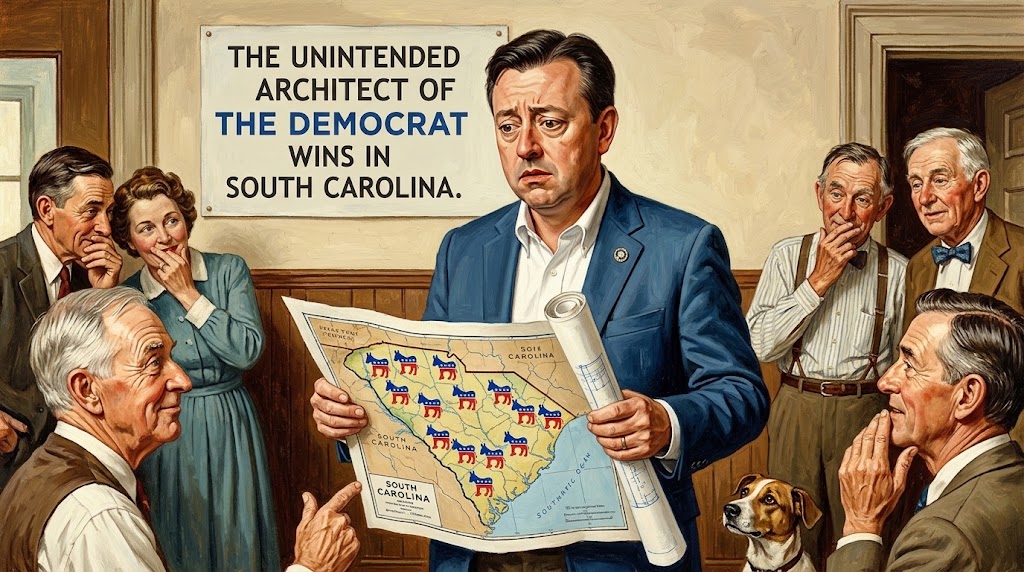
Driven by over-bearing control issues, a parade of factional ego battles, and an insatiable appetite for Washington DC favor, McKissick fractured the SCGOP at its foundation. Instead of protecting constitutional principles and fostering a big-tent movement of liberty-minded South Carolinians, McKissick ran the state party like a petty fiefdom, sacrificing grassroots energy on the altar of his own national ambitions.
Here is the anatomy of a political collapse—and how one man’s thirst for DC power handed South Carolina Democrats their biggest windfall in generations.
The Imperial Chair: Control Issues and Heavy-Handed Rules
To understand the 2026 debacle, one must understand McKissick’s management style, which leaned less “republican governance” and more “late-stage Soviet central planning.”
McKissick, who took the helm in 2017 and clung to power through five terms, developed an intense obsession with top-down party control. Rather than empowering county organizations, the SCGOP leadership under McKissick viewed the grassroots not as the backbone of the party, but as a pesky nuisance to be subdued.
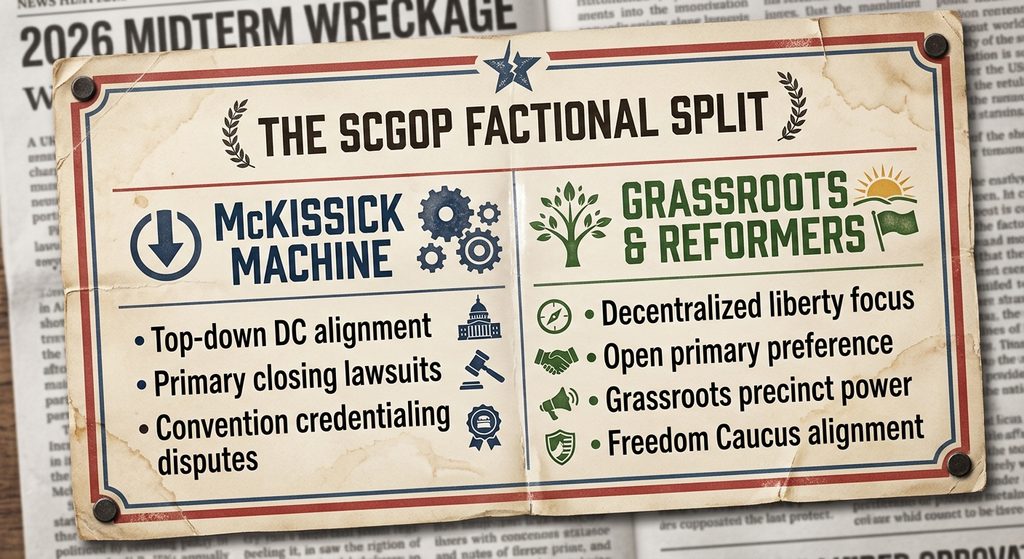
The breaking point arrived ahead of the May 2, 2025 State Convention. In a maneuver that would make Tammany Hall blush, party apparatus leadership effectively moved to disenfranchise and credential-block entire dissenting delegations—most notably targeting rebellious conservative factions from Pickens County and surrounding areas that had dared to vote against McKissick’s machine in prior elections.
While McKissick managed to eke out a 56% win (505 to 367) over former State Senator Lee Bright on May 3, 2025, the victory was pyrrhic. Activists openly labeled the convention “corrupt,” with one disgusted attendee noting that the party’s internal mechanics had become more toxic than the legislature itself.
By treating liberty conservatives, MAGA populists, and constitutionalists as, in the words of critics, “lepers in a dumpster fire,” McKissick succeeded in securing his gavel while alienating the very door-knockers and precinct executives needed to drive turnout. When 2026 rolled around, those activists stayed home—or voted third-party out of pure spite.
Petty Personality Clashes and the Freedom Caucus War
Instead of preparing for the 2026 midterms by uniting the coalition, McKissick spent 2024 through 2026 waging a grueling campaign of attrition against his own party’s legislative wing.
The primary target of the party’s ire? The South Carolina House Freedom Caucus and liberty-minded Republicans who refused to bow to the Columbia establishment. Rather than brokering peace between the party apparatus and reform-minded legislators, McKissick doubled down on division.
Throughout early 2026, McKissick engaged in a high-profile, public war of words over primary election reforms and party purity tests. In a February 19, 2026 op-ed published in The Post and Courier, McKissick openly blasted Republican legislative leadership, threatening that the state committee was preparing to file federal lawsuits against its own state legislature if lawmakers didn’t pass the party’s preferred primary-closing bill (H3463).
When the state party chair spends his time suing Republican lawmakers, publishing scathing op-eds attacking conservative colleagues, and threatening primary challenges against sitting Republicans, the voters notice. While the SCGOP was busy eating its own, South Carolina Democrats sat back, passed the popcorn, and quietly organized a voter registration campaign that exploited the massive vacuum left by a shattered Republican volunteer base.
Bowing to DC: Greed, Ego, and National Ambitions
Why would a state party chairman burn down his own house? The answer lies in the cocktail of ego, Beltway ambition, and the siren song of national political power.
Drew McKissick had long outgrown the Palmetto State in his own mind. After serving as Co-Chair of the Republican National Committee (RNC) from January 2023 until his abrupt displacement in March 2024 during national party shakeups, McKissick developed an acute case of “Potomac Fever”.
Determined to maintain his standing as a national player, McKissick treated the South Carolina GOP not as an institution to serve state voters, but as a stepping stone to regain favor with national powerbrokers, K-Street donors, and presidential kingmakers.
“When a state chairman prioritizes national fundraising galas in Washington over precinct organization in Spartanburg or Horry County, the foundation rots from within.”
Under McKissick, the SCGOP increasingly adopted out-of-touch, DC-consultant-driven playbooks. Millions of dollars raised off South Carolina’s red reputation flowed into out-of-state vendor contracts, glitzy galas, and national consultants, while county-level parties were starved of resources and basic precinct training.
When grassroots conservatives demanded a return to core libertarian principles—fiscal restraint, decentralization, real primary competition, and personal liberty—McKissick offered them administrative lawsuits, closed conventions, and demands for blind party loyalty.
The 2026 Midterm Fallout: A Self-Inflicted Disruption
When the election night returns came in for the 2026 midterms, the consequences of this five-year reign of hubris were laid bare:
- Depressed Conservative Turnout: In key conservative strongholds like Upstate South Carolina, base voter turnout cratered. Disillusioned by years of credentialing games, rigged convention votes, and establishment arrogance, tens of thousands of grassroots activists simply stayed home.
- Third-Party & Independent Surges: Libertarian and independent candidates saw record vote shares in contested state legislative seats, acting as a direct protest against McKissick’s high-handed party apparatus.
- Democratic Pickups: By taking advantage of split Republican tickets and an unmotivated GOP base, South Carolina Democrats seized critical competitive districts in the Midlands and Lowcountry that had been considered safe red seats for over a decade.
A Lesson in Schadenfreude
There is an exquisite, dark irony in watching the political establishment hoist itself by its own petard.
For years, Drew McKissick managed the SCGOP with the heavy hand of a bureaucrat who believed voters had nowhere else to go. He prioritized DC clout over local organizing, personal power over constitutional principles, and internal purges over coalition building.
The 2026 midterm outcome wasn’t a sudden political miracle for the Left—it was a predictable, libertarian-style market correction for a political monopoly that forgot its customers.
As the SCGOP picks up the pieces in the wake of this political trainwreck, one lesson stands out above all others: When you treat your grassroots like peasants and your party like a national resume-builder, don’t be surprised when the voters burn down the castle.