
Petty Politics
Across capitol buildings and cable news studios, an unmistakable pattern has come to define modern American governance. Rather than directing their constitutional mandates toward cutting government spending, pruning burdensome regulations, reducing taxes, or protecting individual liberties, Democrats and Republicans increasingly operate as rival political factions dedicated to weaponizing legislative machinery against each other.
From a libertarian-conservative perspective, government is intended to be strictly limited—its primary function being the defense of property rights and individual freedom. Yet, the public record reveals a two-party system that prioritizes political combat, subpoenas, and retaliatory hearings over structural reform.
1. Historical Record of Partisan Retaliation
Congressional time and committee budgets are finite resources. Over recent legislative sessions, both major parties have demonstrated a habit of redirecting these resources from legislative duties to public investigations intended to inflict political damage.
The Republican House Oversight Strategy
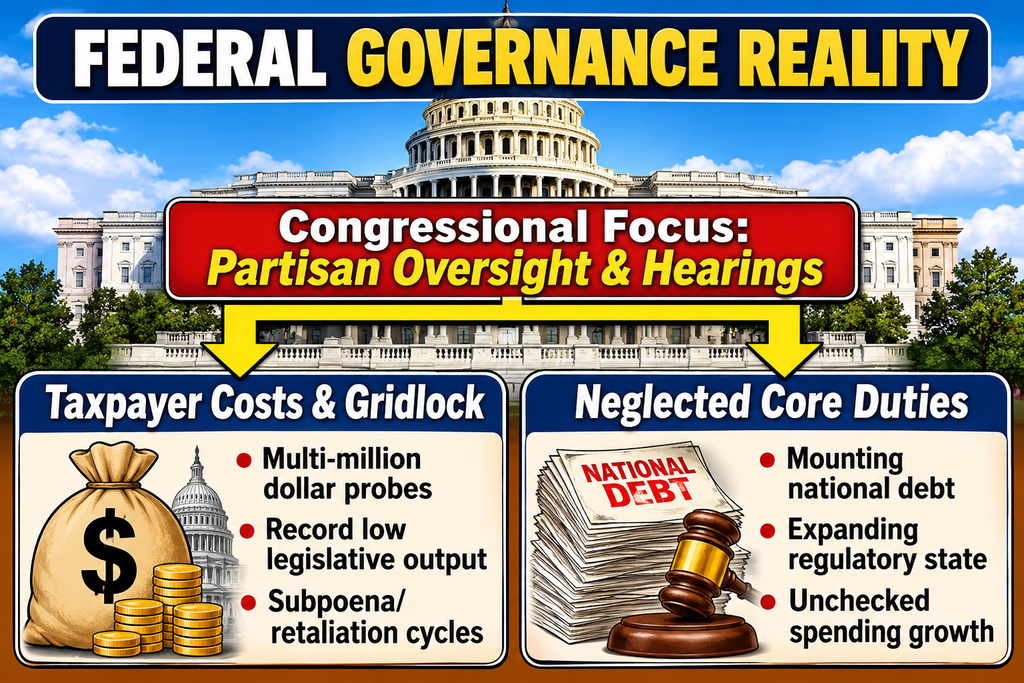
When control of the House shifted in the 118th Congress, committee leadership under figures like Representative James Comer (R-KY) prioritized high-profile investigations into the Biden family and cabinet officials like Homeland Security Secretary Alejandro Mayorkas. While oversight is a valid constitutional function, millions in taxpayer funds and hundreds of hearing hours were allocated to probes that produced extensive media coverage and an impeachment vote, but zero net reductions in federal outlays or regulatory burdens.
The Democratic Trump Investigations
Conversely, during the 116th and 117th Congresses, House Democrats led by figures like Representative Adam Schiff (D-CA) and former Speaker Nancy Pelosi dedicated vast legislative blocks to unremitting investigations of Donald Trump and his administration. Between the Mueller probe (which incurred roughly $32 million in direct and indirect costs), twin impeachment trials, and the Select Committee on the January 6th Attack, legislative calendars were dominated by investigative theater while federal deficits continued to expand unchecked.
2. The High Cost of Political Warfare
The direct financial cost of congressional committees is substantial—with House committee budgets exceeding $150 million annually. However, the real cost lies in the opportunity lost to legislative reform.
- Dwindling Legislative Output: Historical data shows congressional productivity hitting historic lows. Recent sessions, including the 118th and 119th Congresses, enacted a record-few substantive public bills into law. Legislative days are frequently cut short or occupied by procedural posturing.
- Bipartisan Budget Expansion: Despite public rhetoric regarding fiscal responsibility, neither party has taken meaningful action to curb government expansion. The national debt surpassed $34 trillion, with bipartisan consensus regularly passing omnibus spending bills and continuing resolutions rather than implementing entitlement reform or structural spending cuts.
- Expanding Regulatory Oversight: Federal agencies continue to issue thousands of pages of new rules annually, impacting energy, finance, and small businesses, while Congress spends its floor time debating censures, subpoenas, and rule changes.
3. The Libertarian-Conservative Critique
From the perspective of limited-government principles—championed by thinkers like Friedrich Hayek and Milton Friedman, as well as modern figures like Senator Rand Paul and Representative Thomas Massie—the primary objective of federal representatives should be limiting state overreach.
“The government that governs best is that which governs least.” — Common limited-government maxim
When the ruling apparatus focuses on partisan retribution:
- Taxpayer Funds Are Misappropriated: Citizens pay taxes expecting essential public functions, but money is routed into political campaigns masquerading as legislative hearings.
- Individual Rights Are Ignored: Civil liberties, privacy rights, and private property protections take a backseat to surveillance apparatuses and regulatory mandates that neither party works to dismantle.
- The Regulatory State Grows Unchecked: While both parties trade soundbites, unelected administrative agencies steadily expand their authority over the daily lives and businesses of citizens.
4. Summary: The Two-Party Duopoly
The operational pattern in Washington shows that both major parties find greater utility in prosecuting their political opponents than in reducing the size and scope of the federal apparatus. Until voters demand structural reforms—such as strict budget caps, deregulation, and genuine protections for constitutional liberties—taxpayers will continue funding a multi-million-dollar arena where political posturing replaces fiscal discipline.