
HORRY COUNTY, S.C. — Local government rarely announces a loss of liberty with a brass band and a villainous mustache. More often, it arrives as a fee schedule, a zoning amendment, a bond ordinance, a new “standard,” or a line item tucked into an agenda packet.
Across Horry County and its municipalities, a number of recent actions deserve attention from residents who measure government not merely by what it promises to provide, but by what it costs, regulates, restricts, or empowers government to do.
Using a liberty-impact scoring system, the following measures rank among the largest recent restrictions or expansions of local government authority in the Horry County area.
- Horry County Detention Center Expansion: 574 New Beds
Category: Spending / Civil Liberties
Liberty Impact Score: -2.5
The largest direct expansion of government power on the list is Horry County’s proposed 574-bed detention center tower.
Supporters may frame the project as a response to crowding, population growth, public safety needs, or operational demands. Those concerns are real and deserve public discussion. But from a civil-liberties perspective, the construction of hundreds of additional detention beds is not a neutral infrastructure project.
It is an expansion of the county’s incarceration capacity.
More jail space can mean more room for pretrial detainees, more room for people held on nonviolent charges, more room for individuals unable to make bond, and more room for the machinery of arrest, detention, prosecution, and confinement to grow.
The county may argue that it is planning ahead. Critics should ask a different question: Why is the answer to government growth so often more government buildings, more confinement capacity, and more taxpayer-funded enforcement infrastructure?
A free society should be cautious when incarceration becomes one of its most ambitious construction projects.
- Horry County Police Funding Expansion
Category: Civil Liberties
Liberty Impact Score: -2
Horry County’s police-related funding expansion includes accreditation efforts, enhanced training, and new software systems.
Training can improve professionalism. Accreditation can create standards. Software can improve recordkeeping and coordination. But none of those phrases should automatically end the conversation.
Expanded police budgets and technology systems can also mean broader surveillance capacity, more data collection, more institutional reach, and a more permanent enforcement footprint in the lives of residents.
The concern is not that every officer or every training program is inherently harmful. The concern is that government agencies rarely surrender authority once they acquire new tools, new databases, new systems, or new funding streams.
The public should demand clear answers: What data will be collected? Who can access it? How long will it be retained? What oversight exists? What limits prevent software purchased for one purpose from becoming a tool for broader monitoring later?
“Public safety” is important. So are due process, privacy, and the principle that government power should remain limited rather than simply upgraded.
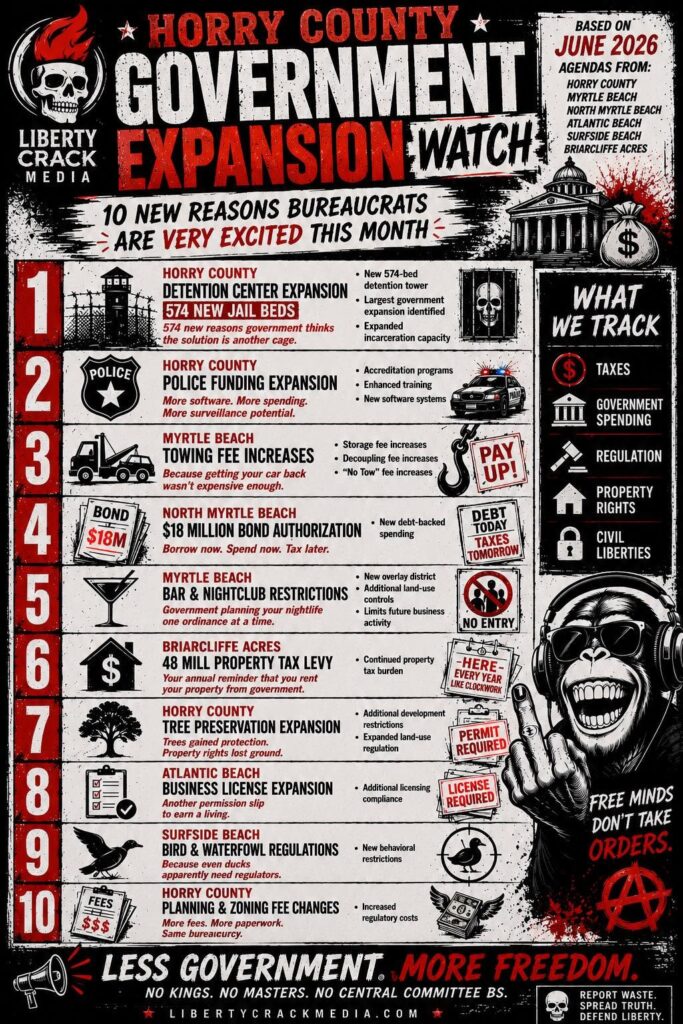
- Myrtle Beach’s Major Nonconsensual Towing Fee Increases
Category: Regulation
Liberty Impact Score: -2
Myrtle Beach’s increases in nonconsensual towing fees may sound like a technical adjustment, but they have a direct impact on residents, visitors, workers, and small businesses.
The changes include increases involving storage fees, decoupling fees, and “no tow” fees. These are not optional marketplace prices negotiated between willing buyers and sellers. They are government-authorized costs imposed when a vehicle owner has limited leverage and little practical ability to shop around.
When a vehicle is towed, the owner is often already in a vulnerable position: stranded, late for work, unable to reach family, or facing a sudden financial emergency. Adding higher government-approved charges turns an inconvenience into a potentially severe financial penalty.
Towing may be necessary in some circumstances, especially where vehicles obstruct traffic, emergency access, private property, or public safety operations. But necessity does not justify treating motorists as open wallets.
Government should be especially cautious when it authorizes price increases in situations where citizens have no meaningful choice, no competitive market, and no ability to decline the service.
- North Myrtle Beach’s $18 Million Bond Authorization
Category: Spending
Liberty Impact Score: -2
North Myrtle Beach approved a first-reading limited-obligation bond ordinance authorizing up to $18 million in accommodations-fee-backed borrowing for facility renovation and expansion.
Debt-backed public spending is often marketed as a way to build now and pay later. That phrase is accurate — but it leaves out the most important detail: taxpayers, visitors, and future residents are the ones who will be paying later.
Borrowing can make projects appear less expensive in the short term because the full cost is spread over time. But debt does not eliminate costs. It delays them, adds financing costs, and makes future budgets less flexible.
The issue is not whether every public project is worthless. The issue is whether government should continue financing expansion through obligations that outlive the officials who approve them.
Elected officials get the ribbon-cutting. The public gets the payment schedule.
- Myrtle Beach Overlay Restricting Large Bars and Nightclubs
Category: Property Rights
Liberty Impact Score: -2
Myrtle Beach’s proposed overlay restricting large bars and nightclubs represents a direct expansion of land-use control.
The measure limits future business activity by placing additional restrictions on where certain entertainment venues may operate. Supporters may argue that the rules are intended to manage noise, crime, traffic, crowd control, or neighborhood compatibility.
But property rights are not merely the right to own a building. They include the ability to use property lawfully, develop it, lease it, invest in it, and operate a business without constantly changing government rules moving the goalposts.
A business owner may purchase property, secure financing, create a business plan, hire employees, and comply with existing regulations — only to find that a new overlay district has made the intended use more difficult, more expensive, or impossible.
Government should punish actual misconduct, not preemptively restrict entire categories of businesses because officials fear what some future operator might do.
A city can enforce noise laws, alcohol laws, fire codes, criminal statutes, and nuisance rules without broadly narrowing the range of lawful enterprise available to property owners.
- Briarcliffe Acres’ 48-Mill Tax Levy
Category: Tax
Liberty Impact Score: -2
Briarcliffe Acres’ 48-mill tax levy represents a direct continuing burden on property owners.
Property taxes are often treated as routine, but they carry a unique liberty concern: they are recurring charges attached to property people already own. Failure to pay can ultimately place that property at risk.
A tax levy may fund local services, but every millage decision should be judged against a basic question: Is government taking only what is necessary, or is it normalizing a larger permanent claim on private property?
For homeowners on fixed incomes, retirees, small landlords, and families trying to hold onto property in a rising-cost coastal market, even a “routine” levy can have real consequences.
Government spending is never free. It is funded by the labor, savings, property, and future choices of the people who live under it.
- Horry County Tree Preservation Standards Expansion
Category: Property Rights
Liberty Impact Score: -1.5
Horry County’s expansion of tree preservation standards adds another layer of land-use regulation affecting development rights.
Protecting valuable natural features can be a legitimate community concern. But the question is not whether trees have value. The question is who should decide how private land may be used, what costs must be absorbed by landowners, and whether the public is willing to compensate owners when regulations reduce the usable value of their property.
Expanded preservation standards can require developers and property owners to redesign projects, preserve designated trees, create buffers, obtain additional approvals, or absorb added engineering and compliance costs. County zoning materials already include landscape, buffer, and tree-preservation requirements in certain development contexts.
Those costs do not vanish. They are passed along through higher home prices, higher rents, delayed projects, reduced investment, or decisions not to build at all.
If the public wants preservation, the public should be prepared to pay for it openly — not simply require individual property owners to carry the burden through regulation.
- Atlantic Beach Business License Standardization
Category: Regulation
Liberty Impact Score: -1
Atlantic Beach’s business-license standardization expands the compliance structure surrounding local enterprise.
Standardization may sound harmless. It can make forms uniform, fees easier to administer, and procedures more consistent. But every new licensing rule, classification, filing requirement, renewal deadline, and compliance obligation creates another hurdle between an individual and the ability to earn a living.
Small businesses do not have legal departments, compliance officers, and accountants on standby. Many are run by families, retirees, tradespeople, entrepreneurs, and people trying to turn a skill into income.
The more complicated the licensing structure becomes, the more government favors established firms that can afford bureaucracy over newcomers who cannot.
Government should make it easier to start and operate a lawful business, not turn entrepreneurship into an obstacle course with a fee at every gate.
- Surfside Beach Bird and Waterfowl Regulatory Ordinance
Category: Regulation
Liberty Impact Score: -1
Surfside Beach’s bird and waterfowl ordinance adds new behavioral restrictions for residents and visitors.
Communities have legitimate reasons to address sanitation, aggressive wildlife, property damage, and public-health concerns. But ordinances governing ordinary behavior — including interactions with birds and waterfowl — should be narrowly tailored, clearly written, and enforced with restraint.
Small rules can create a culture of constant regulation when residents are expected to know and comply with an ever-growing list of municipal restrictions.
The concern is not merely the individual ordinance. It is the cumulative effect: one more rule, one more fine, one more opportunity for selective enforcement, and one more reason for citizens to be treated as violators rather than neighbors.
A government that regulates every minor inconvenience eventually becomes a government that treats normal life as a permit-controlled activity.
- Horry County Planning and Zoning Fee Schedule Changes
Category: Regulation
Liberty Impact Score: -1
Horry County’s planning and zoning fee schedule changes increase the regulatory cost structure for property owners, developers, and businesses seeking approvals.
Fees are often described as administrative necessities. But for citizens trying to build a home, open a business, subdivide property, obtain a permit, or make improvements, fees are another form of government-imposed cost.
A higher fee schedule can discourage smaller projects while larger developers absorb the cost as part of doing business. That creates an uneven playing field: the well-capitalized can navigate the system, while the individual homeowner, local entrepreneur, or small investor may decide the process is simply not worth it.
Regulation is not free merely because it is labeled a fee rather than a tax.
Every dollar required before a person may use his own property is a dollar that government has removed from private choice.
The Larger Pattern
Taken individually, each of these actions can be defended with familiar government language: safety, planning, standards, modernization, environmental protection, public order, and fiscal responsibility.
Taken together, they reveal a broader pattern.
More detention capacity. More police infrastructure. More debt. More fees. More land-use restrictions. More licensing requirements. More municipal rules. More taxpayer obligations.
The danger is not always a single dramatic act of government overreach. It is the slow accumulation of small expansions until residents find themselves paying more, asking permission more often, and exercising less control over their property, businesses, and daily lives.
Horry County residents should pay close attention to agendas, ordinances, budgets, fee schedules, and bond authorizations. The most consequential restrictions on liberty are often not announced in headlines. They are approved in meeting rooms, buried in attachments, and passed before the public realizes what changed.
Liberty is rarely lost all at once.
More often, it is invoiced, zoned, licensed, bonded, regulated, and stored at a daily rate.